


Hastelloy C
Hastelloy C
Quantity:
Hastelloy C
Data grade: Hastelloy C Hastelloy C
American brand: UNS NO6455
German brand: W.Nr.2.4610
Data grade: Hastelloy C Hastelloy C
American brand: UNS NO6455
German brand: W.Nr.2.4610
1. Overview of HastelloyC (NO6455, 2.4610) Hastelloy:
HastelloyC is a tungsten-containing nickel-chromium-molybdenum alloy with extremely low silicon and carbon content.
1. Characteristics of HastelloyC (NO6455, 2.4610) Hastelloy:
(1) It has excellent corrosion resistance to most corrosive media in oxidation and reduction states.
(1) Excellent resistance to pitting corrosion, crevice corrosion and stress corrosion cracking.
2. HastelloyC (NO6455, 2.4610) Hastelloy grades and standards:
HastelloyC is a tungsten-containing nickel-chromium-molybdenum alloy with extremely low silicon and carbon content.
1. Characteristics of HastelloyC (NO6455, 2.4610) Hastelloy:
(1) It has excellent corrosion resistance to most corrosive media in oxidation and reduction states.
(1) Excellent resistance to pitting corrosion, crevice corrosion and stress corrosion cracking.
2. HastelloyC (NO6455, 2.4610) Hastelloy grades and standards:
| Grades and standards | Material grade | technical specifications | ||||||
| Chemical | pipes | plate | Rod | strip | Forgings | |||
| Element | Seamless tube | welded pipe | ||||||
| France | ||||||||
| AFNOR | ||||||||
| Germany | W.Nr.2.4610 | 17744 424 | 17751 | 17750 424 | 17752 424 | 17750 | ||
| DIN | ||||||||
| VdTÜV | ||||||||
| U.K. | ||||||||
| B.S.EN | ||||||||
| USA | UNS NO6455 | B622 SB622 | B619/626 SB619/626 | B575 SB575 | B574 SB574 | B575 SB575 | B366 SB366 | |
| ASTM | ||||||||
| ASME | ||||||||
| 3. Chemical composition of HastelloyC (NO6455, 2.4610) Hastelloy: % | ||||||||
| C≤ | Si≤ | Mn≤ | P≤ | S≤ | Cr≥ | Ni≥ | Mo≥ | Cu≤ |
| 0.01 | 0.08 | 1.00 | 0.015 | 0.010 | 15.0-16.5 | margin | 15.0-17.0 | - |
| other | N≤ | Al≤ | Ti≤ | Fe≤ | Co≤ | V≤ | W≤ | Nb≤ |
| - | - | - | - | 2.50 | 0.1-0.3 | 3.00-4.50 | - | |
4. HastelloyC (NO6455, 2.4610) Hastelloy physical properties:
(1) Density: ρ=8.9g/cm3;
(2) Melting temperature range: 1325~1370℃;
(3), ISO-V notch test: average value ≥120J/cm2, room temperature ≥120J/cm2 -196℃.
5. HastelloyC (NO6455, 2.4610) Hastelloy metallographic structure:
Hastelloy C has a face-centered cubic lattice structure, and its chemical composition ensures metallographic stability and resistance to sensitization.
6. HastelloyC (NO6455, 2.4610) Hastelloy corrosion resistance:
The high content of molybdenum and chromium enables Hastelloy C alloy to resist the erosion of various chemical media, including reducing media, such as phosphoric acid, hydrochloric acid, sulfuric acid, chlorine gas, and organic or inorganic chlorine-containing media. Due to its high nickel content, Hastelloy C is highly resistant to stress corrosion cracking caused by chlorine, even hot chloride solutions.
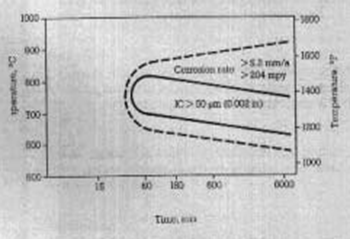
Time-temperature-sensitization curve (carbon content 0.008%, refer to ASTM G28 method A)
(1) Density: ρ=8.9g/cm3;
(2) Melting temperature range: 1325~1370℃;
(3), ISO-V notch test: average value ≥120J/cm2, room temperature ≥120J/cm2 -196℃.
5. HastelloyC (NO6455, 2.4610) Hastelloy metallographic structure:
Hastelloy C has a face-centered cubic lattice structure, and its chemical composition ensures metallographic stability and resistance to sensitization.
6. HastelloyC (NO6455, 2.4610) Hastelloy corrosion resistance:
The high content of molybdenum and chromium enables Hastelloy C alloy to resist the erosion of various chemical media, including reducing media, such as phosphoric acid, hydrochloric acid, sulfuric acid, chlorine gas, and organic or inorganic chlorine-containing media. Due to its high nickel content, Hastelloy C is highly resistant to stress corrosion cracking caused by chlorine, even hot chloride solutions.
Time-temperature-sensitization curve (carbon content 0.008%, refer to ASTM G28 method A)
2. HastelloyC (NO6455, 2.4610) Hastelloy alloy processing characteristics:
1. Processing and heat treatment:
(1) HastelloyC alloy can be manufactured and processed through traditional production processes.
(2) The workpiece should always be kept clean and pollution-free before and during heat treatment.
(3) Full consideration should be given to the sensitivity of the alloy to sensitization when rapidly cooled between 1000°C and 600°C.
(4) During the heat treatment process, do not come into contact with sulfur, phosphorus, lead and other low-melting point metals, otherwise the performance of the alloy will be damaged. Pay attention to removing contaminants such as marking paint, temperature indicating paint, colored crayons, lubricating oil, fuel and other contaminants.
(5) The lower the sulfur content in fuel, the better. The sulfur content in gas should be less than 0.1%, and the sulfur content in heavy oil should be less than 0.5%.
(6) The furnace gas of the heating furnace should be neutral to slightly oxidizing. Fluctuations between oxidizing and reducing properties of the furnace gas should be avoided. The heating flame cannot be burned directly toward the workpiece."
2. Heating:
Workpieces should always be kept clean and free of contamination before and during heat treatment. During the heat treatment process, do not come into contact with sulfur, phosphorus, lead and other low-melting point metals, otherwise the Nicrofer 6616 hMo alloy will become brittle. Care should be taken to remove contaminants such as marking paint, temperature indicator paint, colored crayons, lubricating oil, fuel and other contaminants. The lower the sulfur content in the fuel, the better. The sulfur content in gas should be less than 0.1%, and the sulfur content in heavy oil should be less than 0.5%. Electric furnace heating is a better choice because it can accurately control the temperature and the furnace gas is clean. If the gas from a gas stove is pure enough, you can also choose it. The furnace gas of the heating furnace should be neutral to slightly reducing. The fluctuation of the furnace gas between oxidizing and reducing properties should be avoided. The heating flame cannot be burned directly towards the workpiece.
3. Thermal processing:
(1) The thermal processing temperature range of HastelloyC is 1200℃~950℃, and the cooling pipe is water-cooled or rapid air-cooled.
(2) In order to ensure the best anti-corrosion performance, heat treatment should be carried out after heat processing, and the workpiece should be directly added to the heated heat treatment furnace.
4. Cold processing:
(1) The work hardening rate of HastelloyC is greater than that of austenitic stainless steel, so processing equipment needs to be selected. The workpiece should be in a solution heat treated state and should be intermediate annealed during the cold rolling process.
(2) If the cold rolling deformation is greater than 15%, the workpiece needs to be subjected to secondary solution treatment.
5. Heat treatment:
(1) The solution treatment temperature range of HastelloyC is 1100℃~1160℃.
(2) The cooling pipe is water quenched, and rapid air cooling can also be used for materials with a thickness less than 1.5mm. If air cooling is used, it should be cooled from 1000°C to 600°C within 2 minutes.
(3) During the heat treatment process, the workpiece must be kept clean.
6. Remove oxide skin:
(1) The surface oxide of HastelloyC and the adhesion of the welding slag around the weld are stronger than that of stainless steel. It is recommended to use a fine-grained abrasive belt or fine-grained grinding wheel for grinding.
(2) Before pickling with HNO3/HF mixed acid, the oxide film must be broken up by sandblasting or grinding.
7. Machining:
Due to its sensitivity to work hardening, it is advisable to use low cutting speeds and heavy feeds to get under the work-hardened surface.
8. Welding:
When welding nickel-based materials, the following procedures should be followed:
(1) Work site: The work site should be separated separately or far enough away from the carbon steel processing area, kept as clean as possible, equipped with partitions and avoid ventilation between the two areas.
(2) Clean fine-grained leather gloves and clean work clothes should be worn in work clothes and auxiliary supplies.
(3) Tools and machinery and equipment should have special tools for nickel-based alloy and nickel-chromium steel. Wire brushes should be made of stainless steel. Machinery and equipment such as shears, punches, rolling mills, etc. should be covered with felt, cardboard or plastic paper. This prevents iron-carbon metal from falling on the surface of the machine and causing the processing materials to stick to it, causing corrosion.
(4) Cleaning: The materials to be welded should be in a solid solution state, remove oxide scale, oil stains and various marks and marks, and use acetone to clean the base metal and filler alloy (such as welding rods) in the welding area. Be careful not to use three-dimensional Vinyl chloride TRI, perchlorethylene PER and tetrachloride TETRA.
(5) Edge preparation: It is best to use machining, such as turning, milling, planing, or plasma cutting. If the latter is used, the cutting edge (welding surface) must be ground clean and flat, and fine grinding without overheating is allowed.
(6) Groove angle: Compared with carbon steel, the physical properties of nickel-based alloys and special stainless steels are mainly low thermal conductivity and high expansion coefficient. These characteristics must be considered when preparing the welding groove. This includes widening the bottom gap (1~3mm). At the same time, due to the viscosity of the molten metal, a larger groove angle (60~70°) should be used during butt welding to offset the shrinkage of the material.
(7) Arc starting: The arc cannot be started on the surface of the workpiece. The arc should be started on the welding surface to prevent corrosion caused by the arc starting point.
(8) Welding process: HastelloyC is suitable for any traditional welding process, such as tungsten electrode inert gas shielded welding, plasma arc welding, manual sub-arc welding, metal pole inert gas shielded welding, and melting pole inert gas shielded welding. HastelloyC filler metal, electrode: ENiCrMo-4, wire: ERNiCrMo-4.
3. Application of HastelloyC (NO6455, 2.4610):
1. Application fields:It has been widely used in the chemical and petrochemical fields, such as in components and catalytic systems that come into contact with chloride-containing organic matter. This material is especially suitable for use in high temperature, inorganic and organic acids mixed with impurities (such as formic acid and acetic acid), and seawater corrosion environments. Other areas of application: Pulp and paper industry, such as digestion and bleaching vessels; Scrubbers, reheaters, wet steam fans, etc. in FGD systems; Equipment and components working in acidic gas environments; Reactors for acetic acid and acidic products ; Sulfuric acid condensers; Methylene diphenyl isocyanate (MDI); Production and processing of impure phosphoric acid.
2. Application scope:Hastelloy C is widely used in most chemical industries and high temperature environments. Typical areas of application: flue gas desulfurization systems, pickling and acid regeneration plants, acetic acid and agrochemical production, titanium dioxide production (chlorine method), electrolytic plating.
4. Variety specifications and supply status of HastelloyC (NO6455, 2.4610) Hastelloy:
Shanghai Disheng Special Alloy can produce various specifications of HastelloyC seamless pipes, HastelloyC steel plates, HastelloyC round bars, HastelloyC forgings, HastelloyC flanges, HastelloyC rings, HastelloyC welded pipes, HastelloyC steel strips, HastelloyC wires and supporting welding materials.
1. Processing and heat treatment:
(1) HastelloyC alloy can be manufactured and processed through traditional production processes.
(2) The workpiece should always be kept clean and pollution-free before and during heat treatment.
(3) Full consideration should be given to the sensitivity of the alloy to sensitization when rapidly cooled between 1000°C and 600°C.
(4) During the heat treatment process, do not come into contact with sulfur, phosphorus, lead and other low-melting point metals, otherwise the performance of the alloy will be damaged. Pay attention to removing contaminants such as marking paint, temperature indicating paint, colored crayons, lubricating oil, fuel and other contaminants.
(5) The lower the sulfur content in fuel, the better. The sulfur content in gas should be less than 0.1%, and the sulfur content in heavy oil should be less than 0.5%.
(6) The furnace gas of the heating furnace should be neutral to slightly oxidizing. Fluctuations between oxidizing and reducing properties of the furnace gas should be avoided. The heating flame cannot be burned directly toward the workpiece."
2. Heating:
Workpieces should always be kept clean and free of contamination before and during heat treatment. During the heat treatment process, do not come into contact with sulfur, phosphorus, lead and other low-melting point metals, otherwise the Nicrofer 6616 hMo alloy will become brittle. Care should be taken to remove contaminants such as marking paint, temperature indicator paint, colored crayons, lubricating oil, fuel and other contaminants. The lower the sulfur content in the fuel, the better. The sulfur content in gas should be less than 0.1%, and the sulfur content in heavy oil should be less than 0.5%. Electric furnace heating is a better choice because it can accurately control the temperature and the furnace gas is clean. If the gas from a gas stove is pure enough, you can also choose it. The furnace gas of the heating furnace should be neutral to slightly reducing. The fluctuation of the furnace gas between oxidizing and reducing properties should be avoided. The heating flame cannot be burned directly towards the workpiece.
3. Thermal processing:
(1) The thermal processing temperature range of HastelloyC is 1200℃~950℃, and the cooling pipe is water-cooled or rapid air-cooled.
(2) In order to ensure the best anti-corrosion performance, heat treatment should be carried out after heat processing, and the workpiece should be directly added to the heated heat treatment furnace.
4. Cold processing:
(1) The work hardening rate of HastelloyC is greater than that of austenitic stainless steel, so processing equipment needs to be selected. The workpiece should be in a solution heat treated state and should be intermediate annealed during the cold rolling process.
(2) If the cold rolling deformation is greater than 15%, the workpiece needs to be subjected to secondary solution treatment.
5. Heat treatment:
(1) The solution treatment temperature range of HastelloyC is 1100℃~1160℃.
(2) The cooling pipe is water quenched, and rapid air cooling can also be used for materials with a thickness less than 1.5mm. If air cooling is used, it should be cooled from 1000°C to 600°C within 2 minutes.
(3) During the heat treatment process, the workpiece must be kept clean.
6. Remove oxide skin:
(1) The surface oxide of HastelloyC and the adhesion of the welding slag around the weld are stronger than that of stainless steel. It is recommended to use a fine-grained abrasive belt or fine-grained grinding wheel for grinding.
(2) Before pickling with HNO3/HF mixed acid, the oxide film must be broken up by sandblasting or grinding.
7. Machining:
Due to its sensitivity to work hardening, it is advisable to use low cutting speeds and heavy feeds to get under the work-hardened surface.
8. Welding:
When welding nickel-based materials, the following procedures should be followed:
(1) Work site: The work site should be separated separately or far enough away from the carbon steel processing area, kept as clean as possible, equipped with partitions and avoid ventilation between the two areas.
(2) Clean fine-grained leather gloves and clean work clothes should be worn in work clothes and auxiliary supplies.
(3) Tools and machinery and equipment should have special tools for nickel-based alloy and nickel-chromium steel. Wire brushes should be made of stainless steel. Machinery and equipment such as shears, punches, rolling mills, etc. should be covered with felt, cardboard or plastic paper. This prevents iron-carbon metal from falling on the surface of the machine and causing the processing materials to stick to it, causing corrosion.
(4) Cleaning: The materials to be welded should be in a solid solution state, remove oxide scale, oil stains and various marks and marks, and use acetone to clean the base metal and filler alloy (such as welding rods) in the welding area. Be careful not to use three-dimensional Vinyl chloride TRI, perchlorethylene PER and tetrachloride TETRA.
(5) Edge preparation: It is best to use machining, such as turning, milling, planing, or plasma cutting. If the latter is used, the cutting edge (welding surface) must be ground clean and flat, and fine grinding without overheating is allowed.
(6) Groove angle: Compared with carbon steel, the physical properties of nickel-based alloys and special stainless steels are mainly low thermal conductivity and high expansion coefficient. These characteristics must be considered when preparing the welding groove. This includes widening the bottom gap (1~3mm). At the same time, due to the viscosity of the molten metal, a larger groove angle (60~70°) should be used during butt welding to offset the shrinkage of the material.
(7) Arc starting: The arc cannot be started on the surface of the workpiece. The arc should be started on the welding surface to prevent corrosion caused by the arc starting point.
(8) Welding process: HastelloyC is suitable for any traditional welding process, such as tungsten electrode inert gas shielded welding, plasma arc welding, manual sub-arc welding, metal pole inert gas shielded welding, and melting pole inert gas shielded welding. HastelloyC filler metal, electrode: ENiCrMo-4, wire: ERNiCrMo-4.
3. Application of HastelloyC (NO6455, 2.4610):
1. Application fields:It has been widely used in the chemical and petrochemical fields, such as in components and catalytic systems that come into contact with chloride-containing organic matter. This material is especially suitable for use in high temperature, inorganic and organic acids mixed with impurities (such as formic acid and acetic acid), and seawater corrosion environments. Other areas of application: Pulp and paper industry, such as digestion and bleaching vessels; Scrubbers, reheaters, wet steam fans, etc. in FGD systems; Equipment and components working in acidic gas environments; Reactors for acetic acid and acidic products ; Sulfuric acid condensers; Methylene diphenyl isocyanate (MDI); Production and processing of impure phosphoric acid.
2. Application scope:Hastelloy C is widely used in most chemical industries and high temperature environments. Typical areas of application: flue gas desulfurization systems, pickling and acid regeneration plants, acetic acid and agrochemical production, titanium dioxide production (chlorine method), electrolytic plating.
4. Variety specifications and supply status of HastelloyC (NO6455, 2.4610) Hastelloy:
Shanghai Disheng Special Alloy can produce various specifications of HastelloyC seamless pipes, HastelloyC steel plates, HastelloyC round bars, HastelloyC forgings, HastelloyC flanges, HastelloyC rings, HastelloyC welded pipes, HastelloyC steel strips, HastelloyC wires and supporting welding materials.
| Variety classification | delivery status | |||||||
| Seamless tube | Solid solution + acid white, length can be customized | |||||||
| plate | Solid solution, pickling, trimming | |||||||
| welded pipe | Solid solution acid whitening + RT% flaw detection | |||||||
| Forgings | Annealing + polishing | |||||||
| Rod | Forged state, surface polished or polished | |||||||
| strip | Cold rolled, solid solution soft state, descaled delivery | |||||||
| wire material | Delivered in solid solution pickled disc shape or straight strip shape, solid solution straight strip in fine polished state | |||||||


